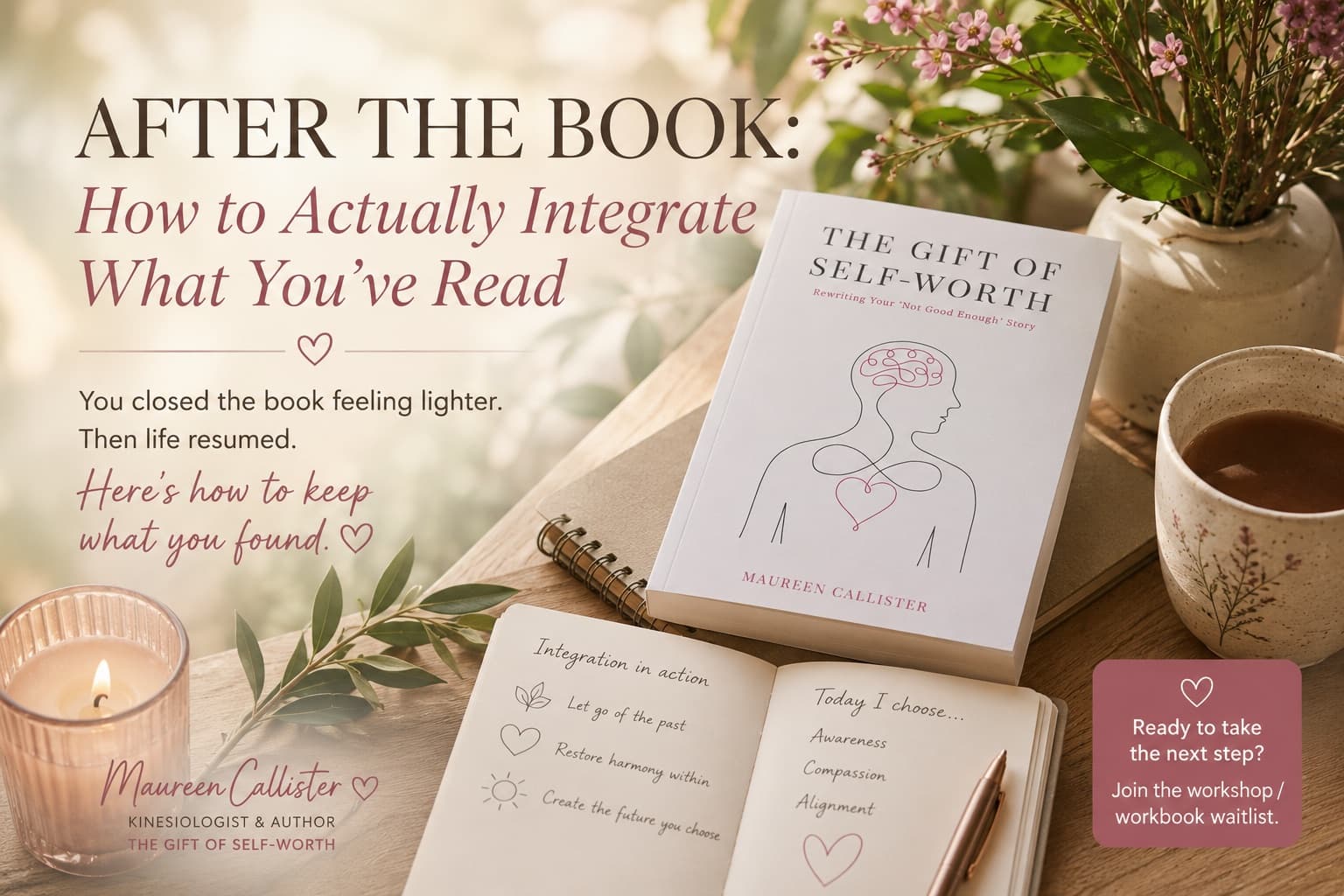
You closed the book feeling lighter. Then life resumed. Here's how to keep what you found.
You’ve finished the book. Congratulations and thank you. Somewhere in its pages I hope you felt that quiet click of recognition, the relief of seeing your own story named, of feeling understood. Did you close it feeling lighter, uplifted or perhaps even resolving to be different. And then a week or two passed, ordinary life resumed, and the old feelings began, quietly, to return. If that’s where you are, let me reassure you straight away: nothing has gone wrong. You’ve simply reached the part of the journey a book can begin but can’t complete on its own. Now I wonder if you are ready for the integration. (The whole journey is Part Three of this series — → The Three-Step Journey to Lasting Change.)
Why reading isn’t the same as changing
A good book gives you insight, and insight is genuinely powerful; it’s the map. The new perspective through the Model of Compassion and greater appreciation for the sophistication of body and mind have provided a desire for more and the motivation for change. But understanding your pattern and being free of it are two different things, and the gap between them catches almost everyone.
Here’s why. The recognition you felt while reading happened in your thinking mind; the part that takes in an idea and says “yes, that’s me”. But the pattern itself; the old belief, the bracing, the not-enough, isn’t held in the thinking mind. It was laid down early, in the body and the nervous system, long before you could read a word. So the insight lands in one place while the pattern keeps running in another, largely untouched. That’s not a failing of the book, or of you. It’s simply the nature of where these things live and it tells us exactly what integration has to do: help the understanding travel from the head into the body.
The three steps of integration
The book gives you the understanding. Living it follows the same three steps as everything else in this work, now applied, deliberately, to your own life.
Step 1, Let go of the past, for real this time. Reading “you are not your story” is moving. Actually releasing the story is something else, because it’s held in the body and won’t leave on command. This is where many readers get stuck: they understand they should let go, and find they can’t simply will the old feeling to lift. Integration means working with the body to release what the mind has now come to understand, through practices that settle the nervous system, balance the hormones and, where the pattern runs deep, through hands-on work like kinesiology that helps the body feel safe enough to let go.
Step 2, Restore harmony within. As the old weight lifts, the nervous system stops working so hard to protect you, the mind quietens, and the body finally relaxes. Living from that calmer, more regulated place is a practice, not a one-time decision (→ Restoring Harmony Within — The Sovereign Heart) which is exactly why it needs structure and repetition rather than good intentions alone.
Step 3, Create the future you choose. As you live more from your true self, your choices begin to change at the root, and a different life quietly takes shape. This is the rewarding part, and it compounds — but it only arrives if the first two steps are genuinely implemented, not just understood.
Practical ways to integrate what you’ve read
- Go slowly, and revisit. Insight fades fast if it isn’t practised. Rather than racing to the next book, sit with one idea from this one for a week. Re-read the chapter that landed hardest. Depth beats volume every time.
- Move it from head to body. After each key idea, ask: where do I feel this in my body? Notice the tightening when the old story speaks. Pair your reading with a daily grounding or breathing practice so the nervous system begins to register safety, not just the mind (→ Grounding for nervous-system regulation).
- Catch the pattern in real time. The book named your pattern; now notice it in the wild. When you over-give, when you flinch at criticism, when the “not enough” voice pipes up — note it, gently, without judgement. Awareness in the moment is where change actually begins.
- Write to yourself. A few honest lines a day to see what came up, what you noticed, what you let go of. This turns abstract insight into lived experience, and lets you see your own progress over time.
- Don’t try to do it alone. This is the big one. We are not designed to change in isolation, and the most reliable predictor of whether an insight becomes a transformation is whether there’s structure and support around it. A reader with a process and some company gets far further than a reader with willpower and good intentions.
Where a workshop or workbook comes in
This is exactly why I built the workshop and workbook around the three steps. The book opens the door; they walk you through it. The workbook gives you the day-by-day practices that move the understanding from your head into your body and your choices. The workshop adds what a book never can; guidance in real time, the felt experience of the work, and the company of others walking the same path, which makes the whole thing both faster and far kinder.
If the book stirred something in you that you don’t want to let fade, that’s the signal to take the next step, before simply reaching for the next book.
Ask about the workshop and workbook · The Three-Step Journey — Part Three