
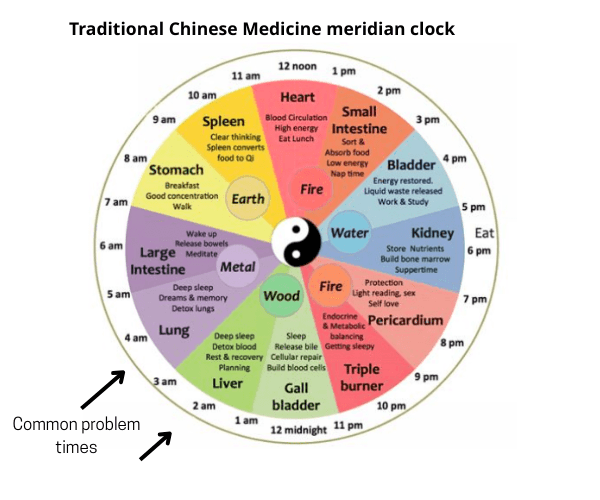
The TCM clock explains why you wake up at a particular time.
Do you repeatedly wake up at the same times during the night and wonder why? According to Traditional Chinese Medicine (TCM), these waking moments may be connected to your body’s energy flow, specifically the meridians, i.e. your body’s acupuncture channels. Today, I want to dive into how the TCM clock can help us understand why we wake up at certain times and what that could tell us about our physical and emotional state.
In TCM, each organ has a specific time window when its energy (or Qi) is most active. These windows follow a 24-hour cycle, and disturbances during certain times of the night can point to an imbalance in the associated organ or meridian.
Let’s look at the key time periods related to sleep:
- 11:00 PM – 1:00 AM – This is the time when the Gallbladder energy is at its peak. If you find yourself tossing and turning during this time, it could be a sign of gallbladder imbalance. The gallbladder is linked to decision-making and courage, so unresolved emotions around decisions or lack of direction could be at play.
- 1:00 AM – 3:00 AM – The Liver is most active during this time. If you wake up feeling restless, or like your mind is racing, it could indicate liver energy imbalance. The liver is associated with anger, frustration, and stored emotions. A person dealing with unresolved anger or stress may experience sleep disturbances during this time.
- 3:00 AM – 5:00 AM – This is the time of the Lung meridian. The lungs are often connected to grief, sadness, and unresolved emotional pain. If you find yourself waking up consistently between these hours, it might suggest that emotional burdens related to grief or loss are affecting your sleep.
Taking It Deeper: The Role of the Five Elements
If this timing doesn’t help you to identify the answer you need, we can look a little deeper. It’s helpful to explore the Five Elements within TCM: Fire, Earth, Metal, Water, and Wood. These elements form a five-pointed star with two key relationships:
- The Shen Cycle – A nurturing and nourishing cycle that supports balance and flow.
- The Ko Cycle – A controlling and balancing cycle that helps regulate energy.
What I often see with clients is that when stress levels are high, it can feel as if life is spinning out of control. In an attempt to regain stability, we may unconsciously try to over-control situations. This, however, can disrupt the Ko Cycle, leading to imbalances that affect sleep and wellbeing.
Sometimes, when the natural meridian cycle is disrupted, it can affect our physical body and show up in the nervous system, muscles, digestion, or pretty much anywhere. You might notice that the pain or discomfort comes and goes rather than being consistently present. It may also move to different areas of the body or feel more intense at specific times of the day. Generally, you’ll have a sense that your system just feels off.
It’s important to address these imbalances early, as the longer they persist, the more likely they are to become habitual and go deeper into the body. Timely intervention helps prevent these disturbances from embedding into your physical and energetic systems.

Sometimes the entire Ko Cycle may need rebalancing, while for others, it might be the specific interaction between two elements that is out of harmony. For instance, stress can disrupt the relationship between Liver (Wood) and Lungs (Metal), or Gallbladder (Wood) and Heart (Fire), causing a ripple effect through the whole meridian system.
Practical Tips for Balancing Meridians
To support balance in the affected meridians, consider the following practices:
- Liver Meridian (1:00 AM – 3:00 AM): Gentle stretching of the inner thighs can help. Acupressure on Liver 8, to tonify or strengthen the flow of energy and Liver 9 to restore balance by calming the emotions and promote the smooth flow of Liver Qi. These points are located on the inner thigh and can be massaged gently to alleviate tension.
- Lung Meridian (3:00 AM – 5:00 AM): Deep breathing exercises and chest-opening stretches can be beneficial. Applying gentle pressure to Lung 1 (Zhongfu), located on the upper chest, may help release grief and support lung function. Hold this point while you breathe deeply with a releasing exhale.

Find out more information about interesting clock times and adopting practises to support you
https://www.naturehealsclinic.com/chinese-medicine-clock/#:~:text=Massage%20Acupuncture%20points%20on%20the,organ%20disharmony%20in%20Chinese%20Medicine.: Waking up at 3pm? Relief – The TCM Clock Holds the KeyA Call to Reflection
Keeping a sleep journal can be a powerful tool. By tracking your sleep disturbances and any emotions present, you may start noticing patterns that reveal deeper insights into your stress or unresolved feelings. Reflecting on your daytime experiences and emotional states can also provide clues to nighttime imbalances.
Sometimes it’s hard to see the full picture on your own—don’t hesitate to reach out for support if you’re feeling stuck. Understanding why the imbalance exists in the first place can be key to not only improving sleep but also enhancing overall wellbeing.
By tuning into your body’s natural rhythms and acknowledging the underlying emotional layers, you can create a more peaceful sleep environment. If you’re curious to learn more about how the TCM clock or the Five Elements might relate to your sleep challenges, reach out—I’m here to help!
Take care and sleep well!