
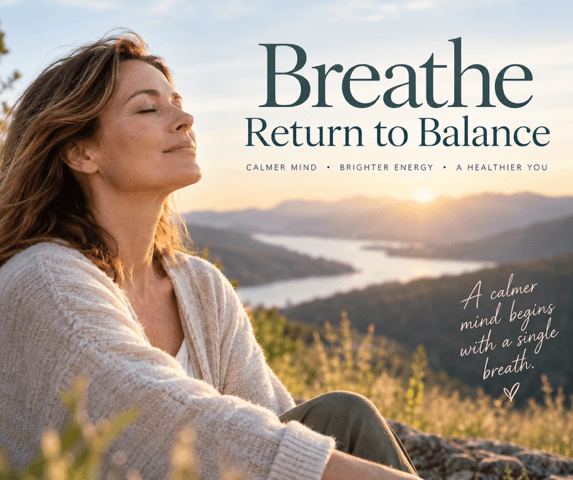
You breathe approximately 20,000 times a day. But how often do you consciously use your breath to change how you feel?
We have all heard the advice: Stop. Take a deep breath.
We say it to a child who is upset. We say it to someone who is panicking. We might even say it to ourselves when everything feels like too much.
But why does it work?
Understanding the answer makes breathing much more than a nice relaxation technique. It becomes one of the simplest tools we have for communicating directly with our nervous system.
And the remarkable thing about the breath is that it is always available to us.
Your body is doing far more than you consciously control
At any moment, your body is carrying out thousands of processes without you having to think about them. Your heart beats. Your digestive system works. Your pupils adjust. Hormones are released. Blood vessels constrict and dilate. Your nervous system is constantly receiving information and deciding whether you are safe or whether you need to protect yourself.
Most of this happens outside conscious awareness.
When the brain and nervous system perceive threat, the sympathetic branch of the autonomic nervous system can become more active. This is part of the familiar fight-or-flight response.
Your heart may beat faster. Your muscles tense. Your breathing can become quicker and shallower. Digestion becomes less of a priority as the body prepares you to deal with whatever it believes is threatening you.
The important word here is believes.
The threat does not have to be a tiger chasing you. It can be an argument, financial pressure, an overflowing inbox, worry about your children, an old emotional trigger or simply the accumulation of too much stress for too long.
Sometimes we don’t even consciously know why we feel anxious or unsettled because the reaction can begin below the level of conscious thought. This is where our understanding of the subconscious and unconscious mind becomes so important.
But there is one automatic function that gives us an extraordinary point of access to this system.
The breath.
The breath is a bridge between the conscious and unconscious
You don’t normally have to remember to breathe. Your brain and body take care of it for you.
But unlike many other automatic functions, you can also deliberately change your breathing. In fact the breath may give you the opportunity to take control of your body and its reaction. You can slow it down. You can deepen it. You can lengthen your exhalation. You can pause and consciously bring your attention to it.
This is why I think of the breath as a bridge.
Through something as simple as changing the way you breathe, you can begin to influence the state of your autonomic nervous system.
Slow, comfortable breathing, particularly breathing that allows the exhalation to become relaxed and unhurried, can support the body’s shift away from heightened sympathetic arousal and towards parasympathetic regulation: the state associated with resting, digesting, recovering and restoring.
You are effectively giving your body new information:
In this moment, I am safe enough to soften.

Anxiety, depression and the need for balance
When someone is anxious, it can feel as though everything inside them has accelerated; thoughts race, the heart pounds, breathing changes, muscles tighten, the nervous system is on alert, scanning for what might happen next.
Depression can present very differently. For some people there is heaviness, exhaustion, withdrawal, reduced motivation or a sense that the body’s energy has been turned down.
These are not simply opposite conditions, and both anxiety and depression can have many contributing factors. But they illustrate something important about mental wellbeing: we function best when our nervous system has flexibility.
We need to be able to mobilise when action is required and then settle again when the danger or demand has passed. The goal is not to remain relaxed all the time. The goal is to be able to move between activation and restoration appropriately.
And this is where the breath can become such a valuable daily practice.
The breath helps us return towards balance.
Your breath changes more than your oxygen
Breathing, of course, brings oxygen into the lungs and allows the body to remove carbon dioxide. But the benefits of conscious breathing are not simply about “getting more oxygen.”
The rhythm and depth of our breathing interact with our cardiovascular and nervous systems. Slow breathing can influence heart-rate patterns and autonomic regulation, while bringing our attention to the breath also gives the busy mind something simple and immediate to focus upon.
There is another benefit that I find particularly valuable.
Breathing brings us back into the body.
When we are stressed, anxious or overwhelmed, we can spend enormous amounts of time in our heads, thinking, analysing, worrying, anticipating and replaying.
The breath brings our awareness back to now. Not yesterday. Not what might happen tomorrow.
This breath. This body. This moment.
Try this: The Restoring Breath
You don’t need complicated breathwork to begin experiencing its benefits.
Sit comfortably and allow your feet to connect with the floor. If it feels comfortable, place one hand over your chest and the other over your abdomen.
Don’t force yourself to take an enormous breath. Simply notice your breathing first.
Then gently allow your breath to become a little slower and softer.
Breathe in comfortably through your nose.
Allow the breath to expand through your ribs and abdomen.
Then breathe out slowly and easily, letting the exhalation be a little longer than the inhalation if that feels natural.
As you breathe out, consciously allow your shoulders, jaw and belly to soften.
Take another gentle breath.
And another.
You might quietly say to yourself:
I am here.
I am safe in this moment.
I can soften.
Continue for a minute or two and notice what changes. Don’t try to force yourself to become calm. Simply give your nervous system an opportunity to find its own way towards greater balance.
You don’t need to wait until you are overwhelmed
One of the mistakes we make with breathing practices is only remembering them when we’re already highly stressed. Breathwork can be even more valuable when it becomes part of everyday nervous-system care.
Take three conscious breaths before answering a difficult email. Pause and breathe before walking into a meeting. Spend two minutes breathing before sleep. Use your breath when you notice yourself becoming impatient, overwhelmed or reactive.
The more familiar your body becomes with moving back towards a regulated state, the easier it may become to recognise when you are moving away from it.
Breathing won’t remove the circumstances causing your stress, and it isn’t a replacement for appropriate psychological or medical care when that is needed, but what it can do is change the state from which you meet those circumstances, and sometimes that small shift creates enough space to respond differently.
The breath brings you home
We often look for complicated answers to stress and emotional wellbeing. Sometimes complicated problems do require deeper work. Old patterns, trauma, subconscious beliefs and unresolved emotions don’t necessarily disappear because we take a few deep breaths.
But healing also needs simple tools.
Tools we can use while standing in the kitchen.
Sitting in the car.
Lying awake at three in the morning.
Waiting outside a difficult appointment.
Or noticing that familiar feeling of anxiety beginning to rise.
Your breath has been with you from the moment you arrived in this world. It asks for no equipment, costs nothing and is available wherever you are.
Perhaps that is why it is so easy to underestimate.
The breath is not simply something keeping you alive.
It is one of the ways you can consciously communicate with your body, support your nervous system and gently guide yourself back towards balance.
Sometimes healing begins with something as simple as remembering to breathe. It’s not called the breath of life for nothing!
Book a session · Take the Journey to Wholeness quiz