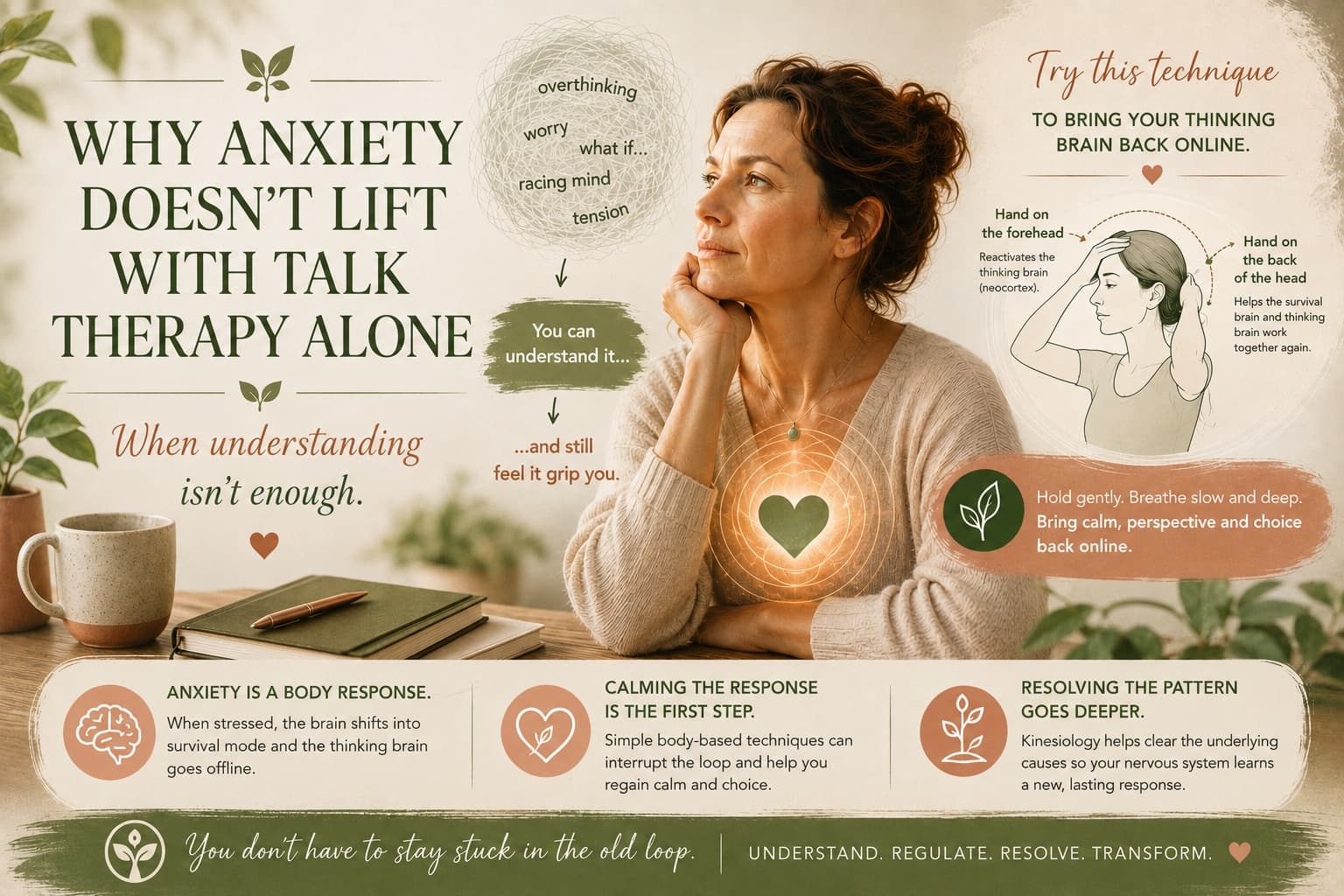
You can understand your anxiety completely and still feel it grip you. Here's why, and something you can do about it.
If you’ve ever sat in a counselling room, understood your anxiety completely, named exactly where it comes from yet still felt it grip you just as hard on the drive home then this is for you. It’s one of the most common frustrations I hear, and it leads good, thoughtful people to conclude there’s something uniquely broken about them. There isn’t. There’s simply a piece of the picture that talking, on its own, tends to miss. (The fuller explanation is Part Two of this series — → What Is Kinesiology.)
What talking reaches and what it doesn’t
Talk-based approaches work with the thinking, reasoning mind. They help us understand our anxiety, reframe our thoughts, make meaning of our experience and that is genuinely valuable, and for some people it’s enough.
But anxiety isn’t generated in the thinking mind. It rises from the older, faster, protective parts of the brain and nervous system, and those parts don’t respond to reason. When something frightens or stresses us, the brain shifts into fight-or-flight, and its whole priority becomes survival. The part best suited to that is sometimes called the “reptilian” brain; it’s the brain stem and cerebellum at the back of the head, and it runs our oldest, most automatic patterns, the ones laid down early in life.
Meanwhile the neocortex, the “executive” brain that handles logic, perspective, and new options, steps back during stress. This is the crucial point: at the very moment you most need calm, rational thought, the rational part of your brain has quietly gone offline. You cannot reason with a system that has switched reasoning off. It’s why “just think about it differently” so often fails in the grip of anxiety, and why understanding your anxiety in a calm moment doesn’t automatically protect you in a stressed one.
This is not a personal failing
I want to say this plainly, because so many capable, self-aware people quietly blame themselves. If you’ve done the work, read the books, talked it through, and you’re still anxious; you have not failed at healing. You’ve been working with the floor of the house where words live, while anxiety is held on the floor below, in the body and the nervous system, where patterns react faster than thought. This is the level of the subconscious mind.
The good news is that the body can be worked with directly, and it can learn a new response. That’s the deeper work I do in sessions. But there’s also something simple you can do for yourself, right now, that works with this very mechanism.
Something to try: bringing the thinking brain back online
One of the gentlest techniques I teach is what we call frontal-occipital holding. It sounds technical; but honestly it couldn’t be simpler.
Rest one hand flat across your forehead, and cradle the other hand on the back of your head, low down where the skull meets the neck. It doesn’t matter which hand you place where, just one on the front and one on the back. Hold both, gently, and breathe slowly and deeply. Stay there until you feel yourself begin to settle; usually only a couple of minutes.
Here’s why it helps. Gently holding the forehead encourages blood flow back to the front of the brain; the neocortex, the part that went offline under stress. As it comes back online, you regain access to perspective and choice, instead of being stuck in the old automatic loop. Holding the back of the head at the same time helps the two areas — the reflexive survival brain and the thinking brain — work together again, rather than one hijacking the other. It’s a small, physical way of telling your system the emergency is over.
Pair it with slow, deep breathing, letting the out-breath be longer than the in-breath. Anxious breathing is shallow and high in the chest, which signals to the nervous system that danger is still here. Slowing the breath does the opposite; it engages the body’s rest-and-repair response. So next time anxiety rises: hold the front and back of your head, breathe low and slow, and stay with it until the wave passes.

What goes deeper?
A technique like this is wonderful in the moment; it interrupts the spiral and hands you back some control. What it can’t do, on its own, is clear the underlying pattern: the specific things your system learned to brace against, often long ago, that keep tripping the switch in the first place.
That is the deeper work of a session. Using muscle testing, we find what your system is actually stressed about; often things the conscious mind has long forgotten, and we help the brain and body build genuinely new responses, so the old loop fires less and less. The technique above is, quite literally, step one. The fuller re-patterning is what we do together.
If you’d like to understand how anxiety lives in the body more fully, that’s the subject of Anxiety Isn’t the Problem: Understanding Your Nervous System.
A note of care: Kinesiology works beautifully alongside other forms of healthcare and emotional support, offering a whole-person approach that considers the body, mind and emotions together. If your anxiety feels overwhelming or is significantly affecting your daily life, it’s important to seek appropriate medical or psychological support as well. The best outcomes often come when we work together, each contributing our own area of expertise.