
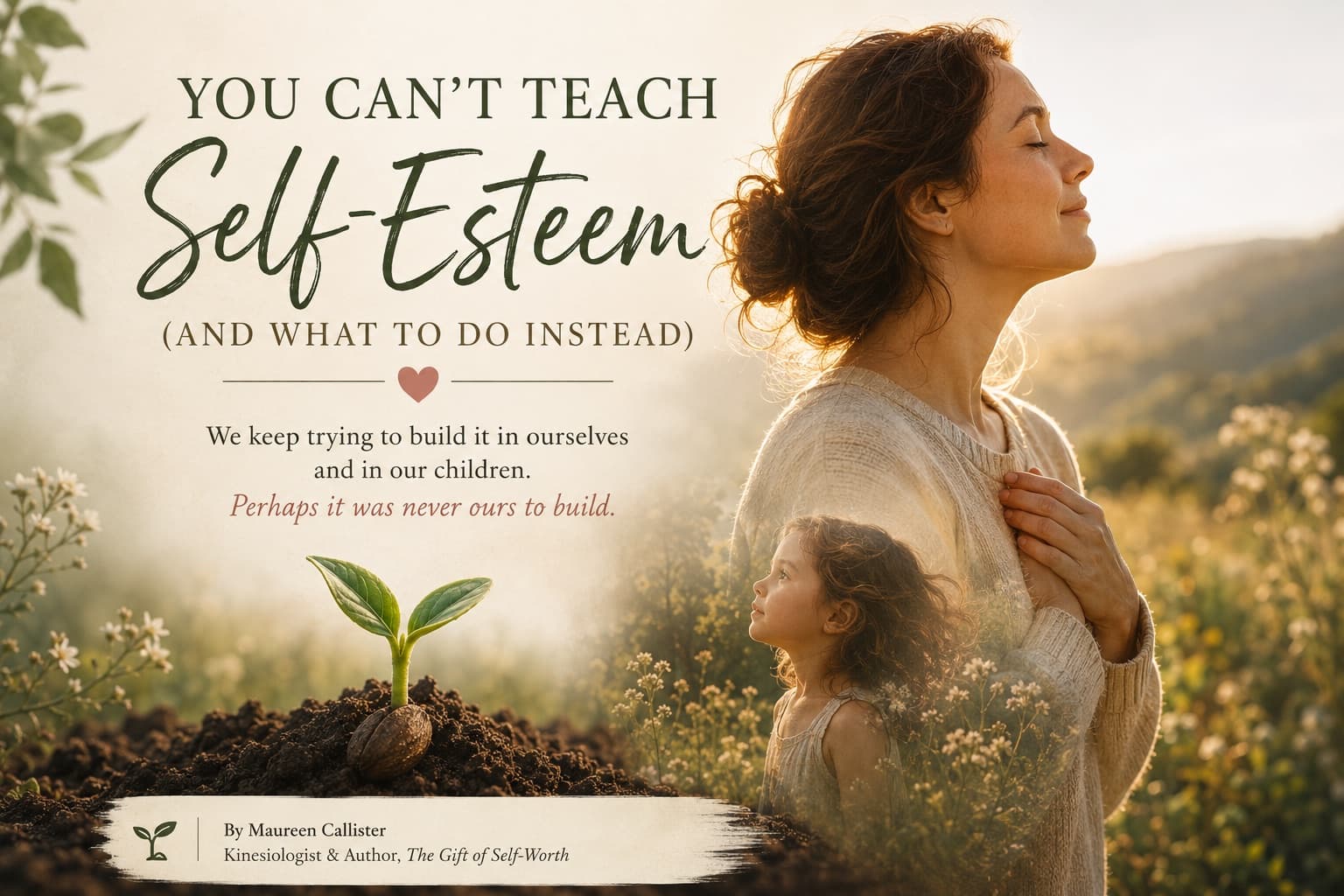
We keep trying to build it in ourselves and in our children. Perhaps it was never ours to build.
For more years than I care to count, I searched everywhere to find the answer to low self-esteem. I searched for the method, the technique, or the set of exercises that would provide the solution for those I worked with, who seemed to have little or none. I wanted, more than anything, to help people who felt fundamentally not good enough. Because I too was intimately aware of the debilitating effects it has on relationships, career, health and happiness. I could see how it fundamentally held back and blocked someone’s confidence, growth and potential for success.
But slowly I arrived at a conclusion that sounded, at first, like the opposite of help: the truth is you can’t teach self-esteem. You can’t install it, fix it, repair it or hand it to anyone.
That sounds discouraging until you understand why I say that, and then it becomes the most hopeful thing I now know. Self-esteem can’t be taught for the simple reason that it isn’t something you acquire in the first place. It’s already in us. It’s part of us. It is the same truth at the heart of this whole series: you were never lacking; your esteem was only ever covered over. (→ Why Do I Feel Not Good Enough — Part One)
Worth can’t come from someone else
Years ago while sitting in a waiting room, I picked up one of those little inspirational books (it was by Dr Wayne Dyer) and I came across a single line in it that I have never forgotten. I can’t remember it exactly but it was the idea that self-worth cannot be given to you by another person, because then it wouldn’t be self-worth at all. It would be other-worth.
Sit with that for a moment, because it quietly undoes most of what we try to do. If your sense of being okay depends on a partner’s approval, a boss’s praise, your children turning out well, or a number on a scale, then it isn’t really yours. It’s on loan, and it can be called in at any time. That isn’t esteem; it’s a permanent audition.
Real self-worth, by its very nature, comes from within. Which also means no one outside of you can take it away. That is the part worth holding onto.
So where did it go?
If we’re all born with it, if it is indeed innate, why do so many of us feel we lack it?
Because it gets covered over, diminished and devalued. Watch a young child before the world has left its marks. She doesn’t wonder whether she deserves to take up space; she simply is. Then life happens, in small and ordinary ways, and somewhere along the line she draws the innocent, mistaken conclusion that there must be something wrong with her. She gets busy becoming whoever she thinks she needs to be to feel safe and loved again. The esteem doesn’t disappear. It goes quiet, underneath.
Think of it like a seed. Everything it needs to flourish is already inside it. Bury it under enough hard ground, keep pressing it down and it won’t grow; not because the life in it is gone, but because the right conditions aren’t there. Our worth is the same. It was never destroyed. It was only ever waiting for the right conditions to come back into the light. For someone to see the value and potential — that someone is now you.
The different task
If esteem can’t be taught, the whole project changes. The job was never to build self-worth from scratch, as though you were missing a part. The job is to uncover the self that’s already there; to gently clear away the layers of doubt, fear and self-judgement so that what was always underneath can be seen again.
That’s a kinder task, and a truer one. It means there is nothing wrong with you to fix. There is only something real to remember, a treasure to be rediscovered. This is the whole principle that I teach in the Model of Compassion — the core principle in my book, The Gift of Self-Worth: Rewriting Your ‘Not Good Enough’ Story. (It’s also why simply building more confidence doesn’t reach the deeper feeling.)
How do we do the uncovering? Gently, and rarely through thinking alone. The beliefs that bury our worth were laid down early and are held in the body, not just the mind, which is why we can understand them perfectly and still feel them. In my practice I use kinesiology to find where those old layers are stored and to help the body feel safe enough to release them. It’s less like learning something new and more like remembering something you’d forgotten was true.
Come from your heart on this one
I’d ask you to take this idea in from your heart rather than your head. If it’s right; if esteem is innate, only ever covered, never truly absent, then we’ve been looking in entirely the wrong direction, and there’s a far gentler way forward. Not striving. Not proving. Not earning. Simply uncovering, with compassion, what was always there.
That’s a more loving way to see a person, including yourself. That is how I see my clients. You are not a project that failed to develop enough confidence. You are a seed that has been waiting, patiently, for the right conditions to grow.
Take the Journey to Wholeness Quiz · Order The Gift of Self-Worth